
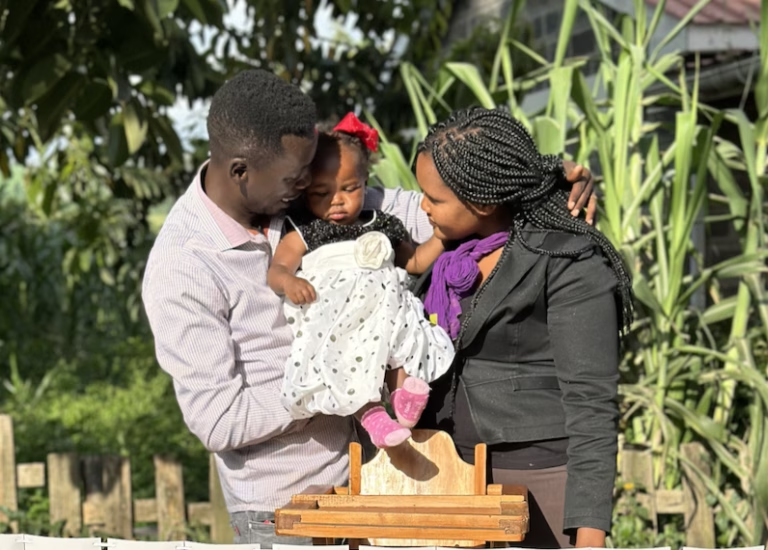
Around the world, children’s homes, or orphanages, exist because sometimes children cannot safely stay where they were.
That is also why we exist.
We are a temporary baby rescue center. Babies come to us in moments of crisis, and for a time we become their consistent caregivers, their temporary family. We learn them, soothe them, and structure our care so they experience safety and attachment.
So the difference between us and many traditional children’s homes is not whether children are loved.- It is what the care is preparing them for.
In some models of care, the goal is to raise children well inside the home itself — providing stability, education, and community all the way through childhood.
But we don’t think a children’s home as a place a child is meant to grow up.
We see it as a bridge.
Everything we do is built around the belief that a child’s long-term place of belonging is a family — biological, foster, or adoptive — not an institution, not even a compassionate one.
Because homes can meet needs, but families shape identity.
A program can keep a child safe.
A consistent caregiver can help a child attach.
But belonging forms when a child knows they are permanently claimed — not just cared for well, but personally rooted. Rooted for longevity, rooted for generational depth.
So our work is always moving in a direction.
We don’t ask: “What we can do to care well for this child as he grows up?”
We ask: “Who is this child’s family and how can we get them there in a safe, loving way?”
This changes how we make decisions.
We keep care consistent, not to replace family, but to prepare a child to trust one.
We limit transitions so attachment can transfer.
We walk with biological families when possible.
We train and support foster and adoptive parents so placement lasts.
Success for us is never a full cottage.
Success is children leaving and not returning.
For a season, we hold babies steady.
But the purpose of that steadiness is that one day someone else will be the one they run to, sleep beside, and call their own. That they will one day have a family and cultural home to bring their own children back to.
A children’s home may be necessary in a child’s story.
But it shouldn’t be the end of it.